Now that the first track has been fully recorded and edited I wanted to review progress so far and discuss some issues we faced and enhancements made in working collaboratively.
We are about a week behind schedule due to difficulties during this stressful time but this does not concern me, there is enough time to simply move the schedule I proposed in the last post forward by a week. I feel that the project is going well overall so far but in order for us to work quickly and efficiently I have decided to start using a workflow template which I will discuss in more detail later on.
One main issue we faced was difficulty in communicating ideas through online messaging, for example I could write lyrics but not explain how I wanted the vocal melody to sound. We decided our collaboration could be enhanced by using video communication as well so we can discuss ideas in real time and play or screen share our ideas to each other. This also proved very helpful when we discovered a file sharing glitch between our two different versions of Logic where parameters of some plugins would change randomly. By both working on the project together at the same time I would know if Ciarán actually changed something or if it was due to the glitch. We also had some significant issues with missing audio files but managed to fix this through trial and error.
I decided I wanted to find a workflow template to follow in order to mix more efficiently as I do not usually work with a combination of live recordings and virtual instruments. I decided to use one from musician and mixing engineer Rob Mayzes who I have been following online for some time. I really like his approach to mixing as it is a top-down approach called ‘slow focus mixing’ (Mayzes, 2016).This approach focuses on mix bus and group bus processing first before refining individual tracks. This is a very efficient and much less overwhelming approach to mixing, especially for beginners like myself. The template includes steps for songwriting, recording, editing, mix preparation, mixing and mastering and helps to make a clear line between each of these steps to improve efficiency (Mayzes, 2018). I have used the editing and mix preparation sections so far and just begun the actual mixing phase by volume balancing.
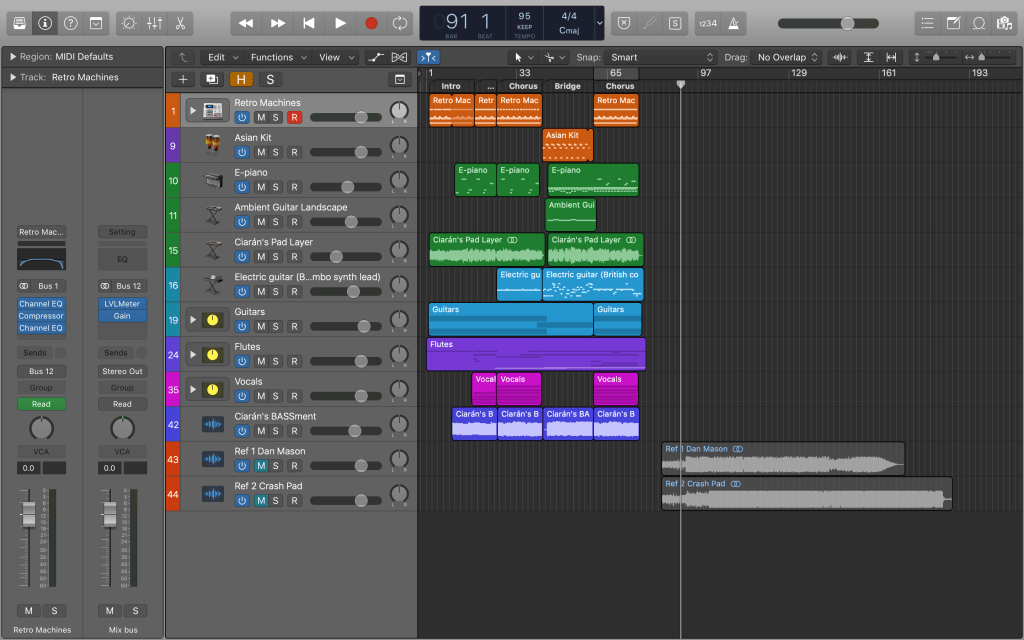
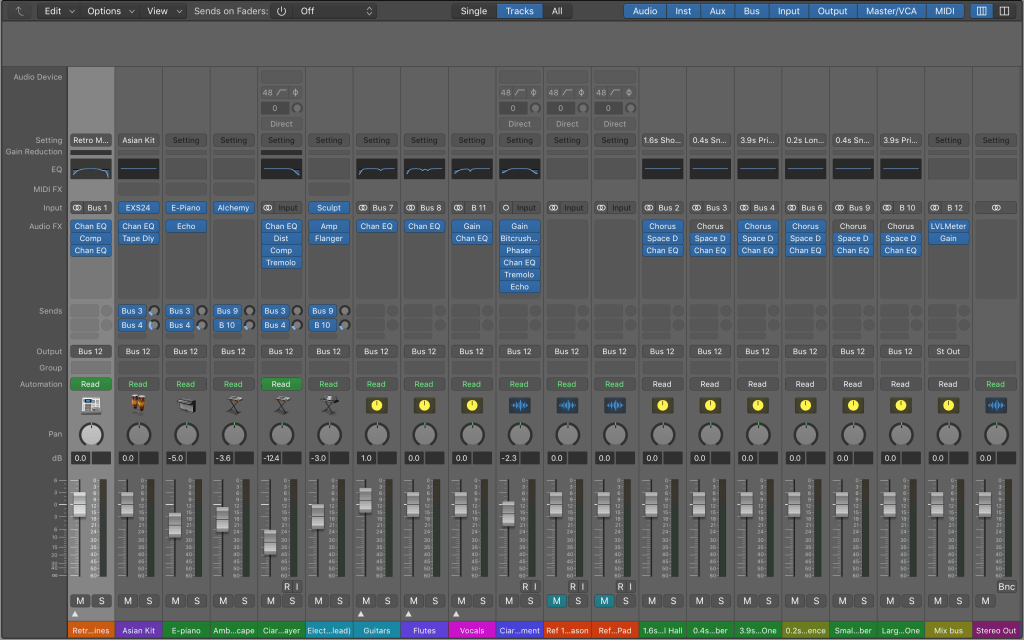
This is how the project looks so far with everything tidied up and ready to begin the actual mixing phase. In my schedule I left the mixing until after both tracks were complete but instead I have decided it would be better to begin mixing now in order to have more breaks between mixing sessions to prevent ear fatigue which is often a problem for me. I will do some of the major group and mix bus processing now and save smaller refinements for the allotted time in my original schedule. Other than slow focus mixing, some things which I am newly implementing with this workflow are fixing time and pitch issues and using subtractive EQ first, which I would usually do when I reach each individual track. I also do not usually mix in mono or use reference tracks until the very end, so it will be interesting to see how this affects workflow and the outcome.
Moving forward with the next track we will also be using the suggested songwriting workflow as I discovered with the first track that songwriting is not something either of us are very confident with.
References:
Mayzes, R. (2016) Backwards Mixing for Better, Faster Mixes | musicianonamission.com [EQ Challenge]. Available at: https://www.youtube.com/watch?v=SY7c2p2BR_Q [Accessed 13th April 2020].
Mayzes, R. (2018). The Music Making Workflow. [online] Musician On A Mission. Available at: https://musicianonamission.training/workflow-charts [Accessed 13th April 2020].
 Damon Siseman MUS634